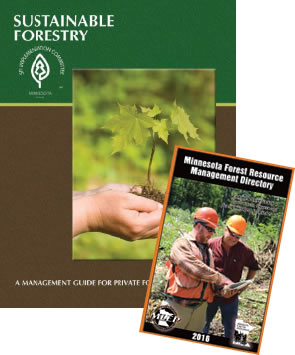
Ensuring the sustainable management of our forests is an awesome responsibility and one in which many people play an important role. With impressively few exceptions, logging business owners are conscientious and responsible managers of the forests that provide for their livelihood and society's recreational and economic demands. The Minnesota Logger Education Program (MLEP) was established in 1995 and provides professional assistance and training to Minnesota's logging community in the areas of sustainable forest management, business management, transportation and safety. MLEP members are required to complete 16 hours of training during their first year and maintain 24 hours of continuing education units during each two-year period thereafter.
Often, the only forest management advice a family forest landowner receives is from a logger. The training and experience MLEP members possess can help facilitate wise and sustainable timber harvest practices. If you are a woodland owner and are considering harvesting some or all of your timber, you should have a forest management plan and contract with an MLEP member logger for your harvesting needs.
A good timber sale contract is necessary to avoid potential misunderstanding and conflicts in the future. Essentially, a good contract should be written and will address four main issues:
The contract should clearly explain which timber is being sold, as well as which is NOT being sold. The contract should specify the price being paid for the timber and exactly when and how you will be paid. The contract should indicate measures for the protection of any timber you are not selling and clearly describe how you want to protect important resources such as soil, streams, lakes, and wildlife habitat. Every person buying or selling timber should formalize the terms of the agreement in a timber sale contract. Essential terms of that contract include:
Methods of Payment
1. Sell the timber as a “lump-sum” amount (i.e. the buyer pays one price, based on the estimated volume of timber).
2. Sell the timber by “consumer scale,” which means the purchaser would have the wood scaled by a third party to determine its quantity. If the consumer scale method is used, the contract should specify the amount to be paid per unit (board feet or cords) for each species (aspen, red pine, jack pine, etc.) and the type (sawtimber or pulpwood).
Regardless of the type of payment, you should get competitive bids to assure that the buyer is paying a fair price for the timber.
Questions To Ask A Logger:
Are you a member of the Minnesota Logger Education Program? What is your membership number?
How long have you been in business? How long have current crew members been with you?
Are you and your employees covered by workers' compensation and liability insurance? What are the dollar limits, and what kinds of accidents are covered? Will you provide me with certificates of workers' compensation and liability insurance coverage?
Do you handle the entire logging process, or use subcontractors for part of the work? If the latter, how do you ensure that your quality goals are met?
What types of roads and skid trails do you normally construct? What equipment do you use to build them? How will my skid trails, landings, and haul roads look when you have completed the logging operation?
How would you handle a dispute over timber trespass (the inadvertent or willful theft of timber) or cutting practices? What options do I have if my or my neighbor's property is damaged?
What Best Management Practices or Forest Management Guidelines do you normally implement? Which ones would be needed on my forest?
Can you supply me with references of previous jobs and to some of the mills you deal with?
Questions For A Logger's References:
Did the logger fulfill verbal and written obligations for such things as road restoration, fence repair, and cleaning up trash?
Was the logger willing to listen to your concerns and answer your questions directly?
Did the logger get the job done efficiently and within the specified time limit? If not, why not? (Be aware that bad weather can cause unavoidable delays.)
Did the logger take pride in his/her workers and equipment? How about in previous jobs? Was the logger willing to show you any of these?
Was the logger careful to avoid damaging other trees and land improvements (gates, fences, culverts, etc.)? If there was damage, did he/she make appropriate repairs?
Did the timber harvester seem concerned about environmental matters, such as wildlife habitat, water quality, and visual concerns?
Did he or she stop or modify operations appropriately during wet weather?
Did the logger communicate well with you? Did the logger explain, for example, any necessary changes in the operation? Was he or she flexible in responding to your needs? How were the logger's relations with foresters and neighboring landowners?
In what shape did the logger leave your skid trails, haul roads, and landings?
Would you use the logger for future timber harvests? Why or why not?